The US Federal Reserve raised its key interest rate by 0.75% to within the 3.75-4% range. This is the 6th consecutive increase in the rent of money since the beginning of monetary normalisation in March and the 4th massive adjustment of 0.75%.
Although such an adjustment is now unlikely at the next meeting of the major US funders, they plan to raise the key interest rate to a higher level than previously expected. The speech given at the press conference by Fed President Jerome Powell leaves little doubt. After the initial sprint to quickly raise the rent of money, the Federal Reserve will start a marathon leading the key interest rate to a long-awaited peak.
High inflation, still at 8.2% in September, continues to dictate US monetary policy. As the Fed President has said, it is better to do too much to ease inflationary pressures than not enough. It will always be possible to adequately lower the key interest rate to adjust monetary policy in the event of a recession. While if inflation expectations anchor at a high level, it will be too late to act. Price slippage will be uncontrollable.
The big American funders want to continue the rise in interest rates because inflation no longer comes from the boom in energy prices but from an excess of demand that pushes up the cost of all goods and services. In addition, despite the economic slowdown and full employment, the other objective of the Fed, with the control of inflation, is still in order. The labour market remains tense with shortages and a sharp rise in wages. Since the beginning of the year, 407,000 jobs have been created each month, including 261,000 in October. Over the past 12 months, hourly earnings have increased by 4.7%.
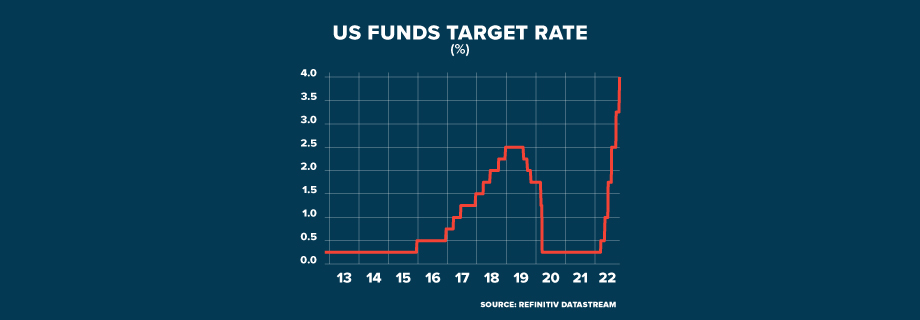
The Fed’s monetary tightening may derail the U.S. economy, but it’s the only way to stop the inflationary spiral. The American economy has all the cards to overcome the crisis and resume its progress quickly. U.S. equities are key.
Furthermore, dollar bonds are also attractive with the rise in interest rates.