Financial markets had gradually priced in a de-escalation of tensions. Oil prices had fallen back towards pre-crisis levels, inflation expectations had moderated and attention had shifted back to economic fundamentals.
That narrative has now changed.
Renewed tensions increase the risk of disruptions to energy supplies in the Middle East, a region that remains central to global oil production and transportation. Even without physical supply interruptions, higher geopolitical risk typically pushes energy prices higher as markets price in greater uncertainty.
For investors, higher oil prices matter because they can feed directly into inflation, corporate costs and consumer spending.
How Could Higher Oil Prices Affect Inflation?
Energy prices remain one of the most important drivers of headline inflation.
If crude oil continues to rise, central banks may find it more difficult to achieve their inflation targets. Higher transportation, manufacturing and logistics costs often spread throughout the economy, delaying the return to lower inflation.
This creates a difficult balancing act for policymakers.
In Europe, persistently high energy prices could justify maintaining restrictive monetary policy for longer than markets currently expect.
In the United States, the Federal Reserve faces competing pressures between supporting economic growth and preventing inflation from accelerating again.
The longer oil prices remain elevated, the less room central banks may have to reduce interest rates.
What Does This Mean for Bond Markets?
The outlook for fixed income has also become more challenging.
Bond yields had eased in recent weeks as investors expected inflation to continue slowing. However, structural forces were already limiting the potential for a significant decline in long-term yields.
One of those forces is the extraordinary investment cycle driven by artificial intelligence.
Massive investment in data centres, cloud infrastructure, semiconductors and electricity networks continues to support demand for capital while placing pressure on selected supply chains.
At the same time, governments around the world continue to issue record amounts of debt.
The United States is financing persistent fiscal deficits, Europe is investing heavily in defence and energy transition projects, and many developed economies continue to rely on elevated public spending.
Meanwhile, the world's largest technology companies are investing hundreds of billions of dollars to expand their AI capabilities.
Taken together, these factors suggest that demand for capital is likely to remain exceptionally strong, making a sustained decline in long-term bond yields less likely than many investors anticipate.
How Could Equity Markets Respond?
Equity markets face two primary risks.
The first is uncertainty.
Geopolitical instability reduces business visibility, increases operational risks and raises the cost of energy and transportation for many industries. Companies with complex international supply chains may be particularly exposed.
The second risk is higher financing costs.
Much of today's market leadership comes from technology companies investing aggressively in artificial intelligence. Those investments require continuous access to capital.
If interest rates remain elevated, financing becomes more expensive, potentially slowing investment and putting pressure on future earnings growth.
Given the significant weight of large technology companies in global equity indices, this could affect broader market performance.
Investment Implications: Why Portfolio Quality Matters
Periods of geopolitical uncertainty rarely justify dramatic portfolio changes, but they do reinforce the importance of disciplined diversification.
Investors may benefit from focusing on assets that combine resilient cash flows, strong balance sheets and high credit quality.
Within fixed income, high-quality sovereign and investment-grade bonds can continue to play an important role in generating income while helping diversify portfolio risk.
For this reason, Norwegian government and high-quality Norwegian fixed-income securities remain an important component of our portfolios, offering an attractive balance between credit quality, yield potential and portfolio resilience.
Key Takeaways for Investors
The end of the ceasefire has shifted investor attention back to geopolitical risk at a time when markets were increasingly focused on economic fundamentals.
Should energy prices remain elevated, inflation may prove more persistent than expected, potentially delaying interest rate cuts and creating additional pressure on both bond and equity markets.
While uncertainty is likely to remain high in the near term, maintaining a diversified portfolio centred on quality assets and long-term investment discipline remains one of the most effective ways to navigate an evolving macroeconomic environment.
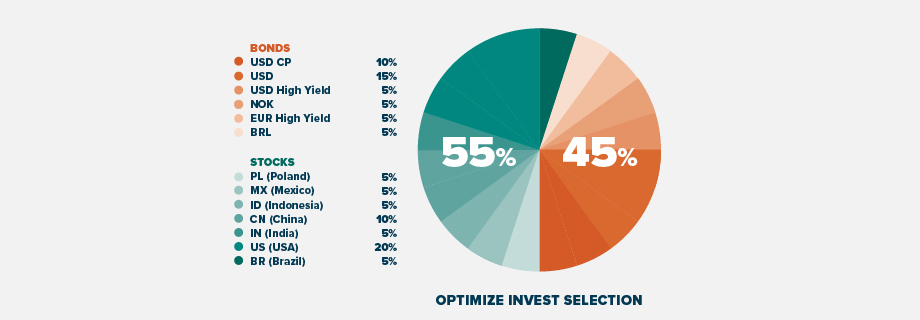
For more information about the fund characteristics, terms and conditions, and factsheet visit https://optimize.pt/en/investment-funds/invest-selection/