While the United States has taken control of Venezuela, markets have so far remained unmoved. Will they eventually benefit from recent developments? In our view, the answer is yes. Here is why.
The US economy: a long-term winner
If the United States has chosen to secure Venezuela, it is primarily assumed to be in order to gain control over the country’s oil resources. One of Donald Trump’s key priorities is to ensure access to cheap energy for the US market. The potential benefits for the American economy are multiple.
First, US households are highly sensitive to fuel prices. The lower the pump prices, the more consumers can redirect spending toward other goods and services.
Second, sticky and still slightly elevated inflation limits the Federal Reserve's room to cut policy rates further. Lower energy prices could ease inflationary pressures, paving the way for cheaper credit, which would in turn further stimulate the US economy.
An additional advantage for the occupant of the White House is political. Should some of these benefits materialise in the coming months, they would represent a significant electoral argument ahead of the midterm elections. For now, Donald Trump holds a majority in both chambers of Congress, and Venezuela could help preserve it.
A genuine long-term strategy
It would nevertheless be reductive to see Washington’s actions as merely a short-term tactic. By placing Venezuela under its tutelage, the United States strengthens its status as the dominant power on the American continent, consolidates its grip on the global oil market, and sends a warning to any challenger to its authority.
From an economic perspective, Donald Trump is securing for US households and businesses an almost inexhaustible source of abundant and cheap energy, given the scale of Venezuela’s reserves. This represents a significant and durable competitive advantage.
At a time when European and Japanese competitors are hampered by high energy costs, structurally cheap energy provides “Made in USA” with a lasting edge. It also allows the United States to better compete with China, which benefits from very competitive energy prices thanks to massive investment in production and distribution infrastructure.
In an initial view, recent events may seem unrelated to the America First policy. In reality, the United States is reinforcing the foundations of its power. Cheap energy and lower borrowing costs are two key conditions for investment in artificial intelligence, particularly in the data centres required to support it.
Such investment has driven US growth in recent quarters, and recent developments create the ideal environment for this trend to continue, strengthening US technological dominance, especially in AI.
Deep geopolitical consequences
At the same time, US actions weaken the position of its strategic adversaries. Control over global oil markets plays a role here. Venezuela is a founding member of OPEC, but under US tutelage, it is likely to distance itself from the cartel and actively undermine efforts to put a floor under oil prices. This would ensure cheap energy for the United States while limiting oil and gas revenues for strategic rivals such as Russia.
By securing Venezuela, the United States is also targeting China. China has been the largest investor in Venezuelan production capacity in recent years, and around 5% of its oil imports currently come from the country.
While this figure must be put into perspective (China could increase its reliance on Russian supply), it highlights Washington’s determination to curb Chinese influence within its sphere of influence: the American continent.
The geostrategic impact does not end there. Already weakened, the Cuban regime is unlikely to survive the loss of cheap Venezuelan oil. Donald Trump and his Cuban-American Secretary of State, Marco Rubio, are therefore playing on multiple fronts and may be close to achieving what no US president has managed since 1959: forcing Havana to bend.
A major movement which raises ethical questions
Intervention in Venezuela marks a turning point for the United States and for America First. Initially, the strategy focused on protecting the domestic market.
At the start of the second year of the mandate, the objective is now to project American power - not to defend principles or democracy, but to provide the country with the means to remain the dominant power while weakening strategic adversaries and entrenching US hegemony.
The White House is therefore laying the foundations for a new era of growth and, if events unfold as intended, US companies and equity markets are likely to benefit in the end.
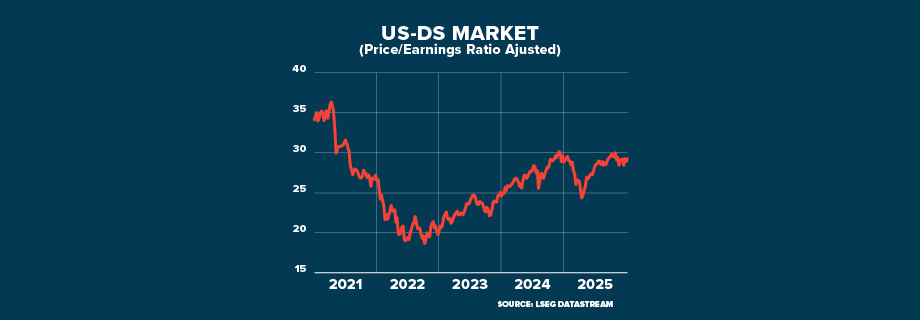
At this stage, the balance of power makes it difficult to bet against the United States. Despite valuation levels that appear high to us and the ethical questions raised by this new strategy, we continue to invest in the US across all our diversified portfolios.